Share this
 Alexander Jansen
on Apr 20, 2026 11:00
| Updated: Apr 30, 2026 15:28
Alexander Jansen
on Apr 20, 2026 11:00
| Updated: Apr 30, 2026 15:28
.png?width=672&height=378&name=Claud2e%203Code%20blog%20April%20(1).png)
Most cloud data pipelines today are sold on promises. Professionals believe in autonomous insights, such as instant transformation, and the idea that a tool alone can solve a cultural data debt.
In practice, senior leaders know these claims rarely survive the first encounter with messy, real-world schemas. Crystalloids doesn’t trade in that marketing hype. We focus on the technical backbone: building reliable, scalable architectures on Google Cloud that actually deliver under pressure.
True value isn't 'unlocked' by a vendor's catchy slogan. It is earned through rigorous engineering and stable data pipelines.
Cloud data pipelines: what to look for in URLs
Looking at cloud data pipelines, the URL structure of your endpoints reveals the quality of your integration. Look for consistent, resource-oriented URL patterns that reflect a native Google Cloud hierarchy rather than opaque, vendor-specific strings.
Clean URLs mean your services (BigQuery, Dataflow) are using a standardized, well-governed API layer. Opaque or complex URLs usually signal proprietary "black box" middleware. These hidden layers often become bottlenecks and make debugging nearly impossible as your data grows.
Services, audience, and value proposition
Whether you need a robust engine for your engineering team or a reliable ‘black box’ with solutions for your marketing department, Crystalloids builds for long-term stability. We avoid the trap of quick fixes that lead to technical debt. Instead, we focus on rigorous data governance. By prioritizing architectural integrity over temporary patches, we ensure your platform remains scalable and compliant as your data needs evolve.

Architecture signals: ingestion, transforms, orchestration, and storage
Modern architecture focuses on more than just a few data sources. This volume is a poor indicator of value. A strong system requires a disciplined orchestration layer. By using Google Cloud Composer and ETL-style transforms, you ensure data is structured and validated before activation.
This approach prioritizes long-term stability over the quick fixes typical of proprietary black box solutions. Whether you need a high-performance engine for engineers or a governed environment for marketers, the focus remains on data governance. Clean, reusable models provide a reliable foundation for decision making and automated activation, which enables scalability.
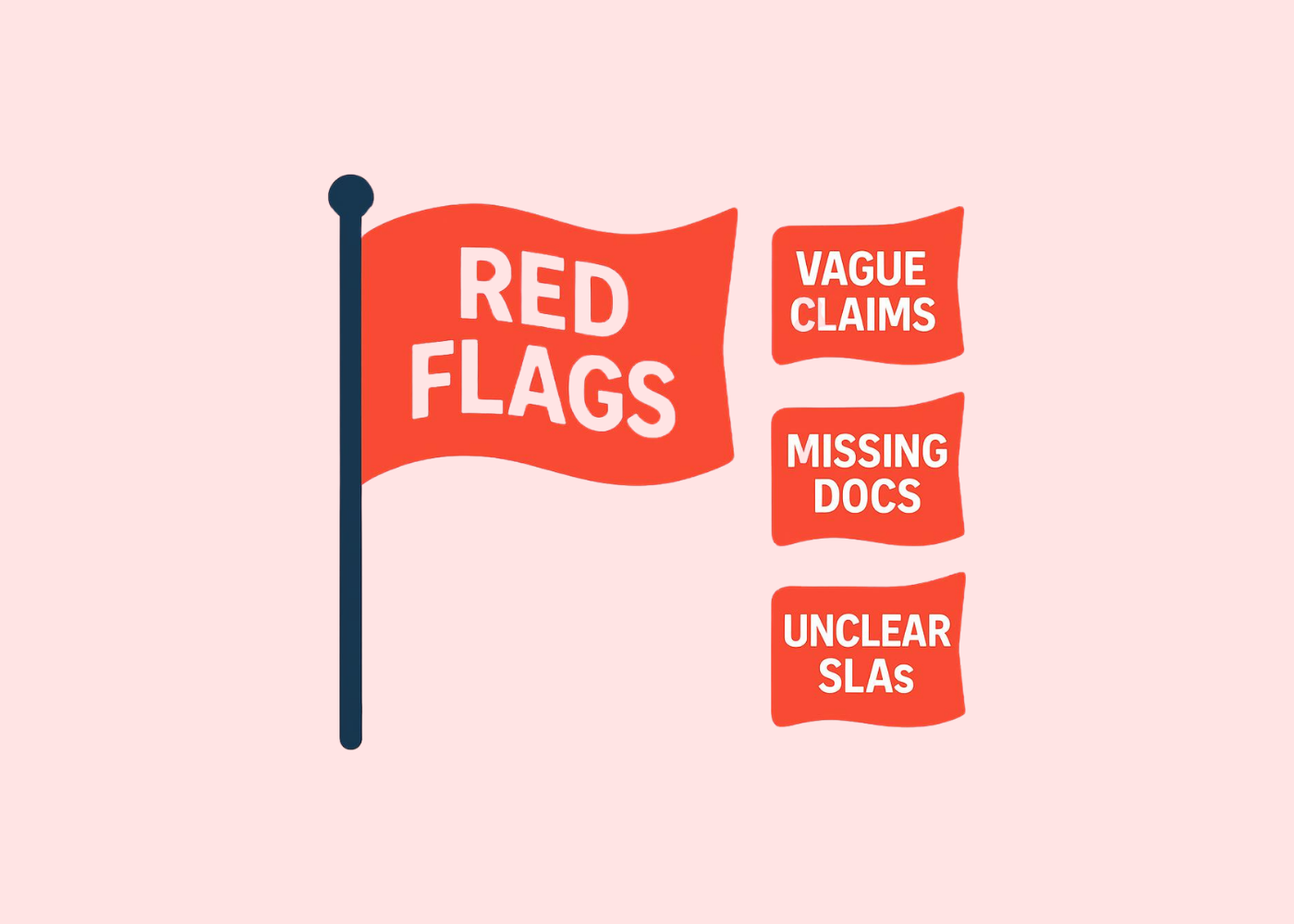
Red flags: vague claims, missing docs, unclear SLAs
Be aware of AI-powered buzzwords that lack transparent documentation or open API access. Many vendors use these labels as a shroud for black box solutions that prevent engineers from auditing the underlying logic.
Incomplete SLAs are another major warning sign for any business requiring 24/7 reliability. A Service Level Agreement defines the specific guarantees for system uptime and support response times to ensure your data operations remain reliable and accountable.
Without a rigorous service level agreement, a quick fix becomes a long-term liability. We prioritize architectural transparency and clear performance guarantees to ensure your platform remains stable and accountable under pressure.
Pricing and limits: throughput, latency, and governance
To avoid scaling traps, assess the FinOps impact of volume-based versus compute-based pricing models. Volume-based fees often seem attractive early on. Compute-based pricing in platforms like BigQuery offers better control by charging for used resources. Focus on actual resource usage instead of storage size.
Prioritize vendors with built-in compliance and clear data lineage to ensure you can trace every data point for audits and debugging. This approach prevents expensive manual oversight and ensures your architecture remains stable as operations expand.
Cloud data pipelines: a summary
The best data pipeline is the one that simply works behind the scenes as a reliable technical backbone. Instead of chasing hype, choose a foundation built on engineering expertise and architectural stability that requires minimal intervention. This ensures your platform remains a silent, high-performing engine that supports long-term growth. Contact us to build a data foundation that delivers results without the noise.




%20(1).png?width=75&height=75&name=Contact%20Services%20(800%20x%20800%20px)%20(1).png)